
From Office to Oasis: The Ultimate Guide to the 2026 Home Office Setup
- Dec 23, 2025
- 5 min read
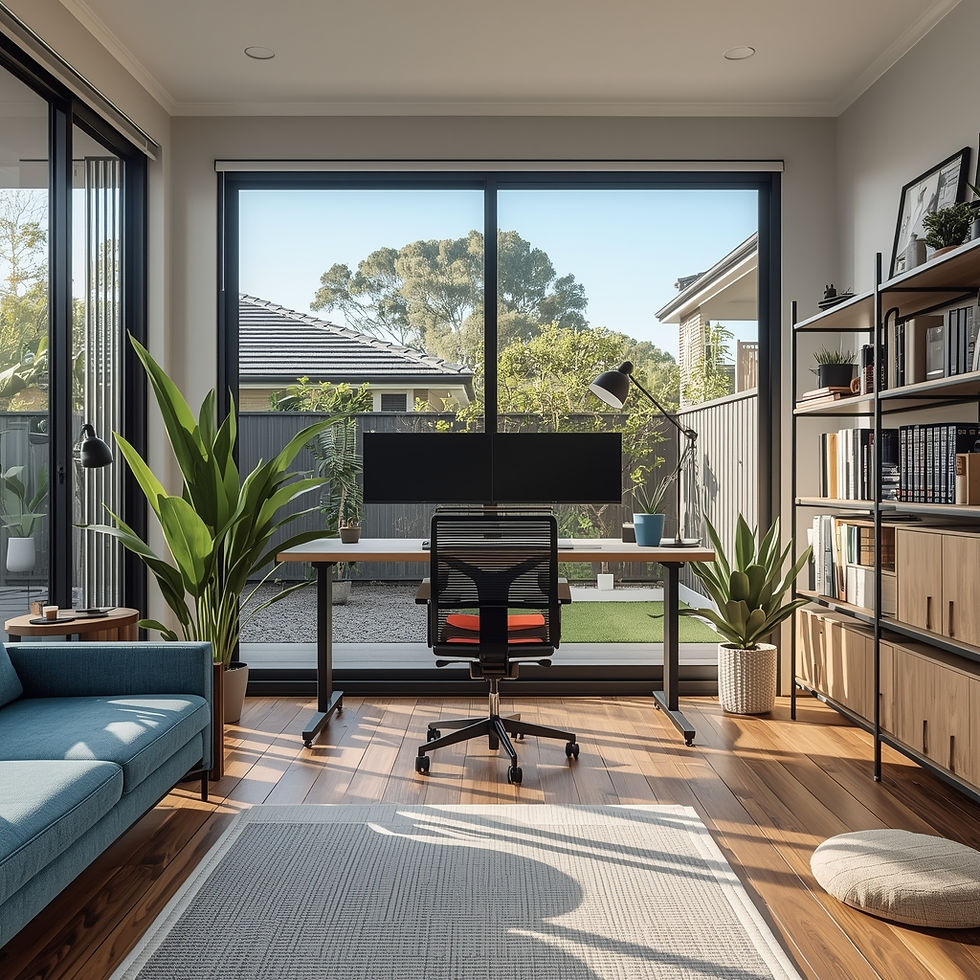
The way Australians work continues its transformation. As we enter 2026, the data reveals a sustained shift: whilst a KPMG survey of 1,300 global CEOs predicted that 64% believe everyone will return to offices by 2026, Australian reality tells a different story. According to the latest research, 88% of Australians still prefer to work from home at least partially, with 60% favouring hybrid arrangements that balance office and home working.
This isn't wavering—it's solidifying. For remote workers and upsizers seeking larger homes with dedicated workspace, creating the perfect home office setup has become essential infrastructure, not optional luxury.
"The home office has evolved from a luxury to a lifestyle necessity," says Paul Virdi, Director of Alpha Real Property Group. "As we move through 2026, we're seeing sophisticated demand from buyers specifically seeking properties with dedicated office spaces or the conversion potential to create them. The data is unequivocal: Australians are willing to upsize to accommodate their work-from-home needs, and Domain's 2026 Forecast Report confirms this trend is reshaping property values across all capital cities."
The 2026 Australian Remote Work Landscape: What the Data Shows
The statistics paint a compelling picture of entrenchment, not retreat. Approximately 40% of Australians now work from home regularly, maintaining the dramatic elevation from the pre-pandemic baseline of just 13% for full-time workers. Roy Morgan research confirms that more than 6.7 million Australians work from home at least some of the time throughout 2025–2026.
In Sydney's CBD, hybrid and remote arrangements still encompass nearly 70% of workers, whilst Melbourne maintains close rates at 65%. Finance and insurance sectors lead with 66% of workers operating remotely, followed by communications at 61%. Perhaps most significantly, 97% of Australian organisations continue offering some form of flexible remote working as 2026 progresses.
The Australian HR Institute reports that 62% of employers believe offering remote work improves their ability to attract and retain staff, whilst 43% say it enhances organisational productivity. This data underscores why remote work persists despite CEO preferences for office returns.
The 2026 Upsizing Trend: Property Market Dynamics
Domain's 2026 Forecast Report reveals established dwelling prices are expected to rise by approximately 6.9% throughout 2026, driven by tight supply and robust demand. This creates ideal conditions for homeowners leveraging capital gains to upsize into properties with dedicated workspace functionality.
The National Housing Supply and Affordability Council's latest data confirms that accumulated housing shortfalls—estimated between 200,000 and 300,000 dwellings—continue creating intense competition. Properties featuring purpose-built studies or rooms suitable for home office conversion command premium prices, particularly in Brisbane, Adelaide, and Perth where property values have experienced substantial growth.
Sydney's median house price is forecast to reach $1.92 million by year-end 2026, with Melbourne recovering to $1.17 million, and Brisbane reaching $1.19 million. This growth creates substantial equity for strategic upsizers prioritising work-from-home functionality. As Domain's Chief of Research Nicola Powell notes, buyers continue chasing affordability whilst seeking properties that accommodate modern work-life integration.
The Essential Home Office Setup: 2026 Investment Breakdown
Creating a productive home office requires strategic investment. Australian remote workers in 2026 can expect to spend between $550 and $3,800 on a complete setup, reflecting slight inflation adjustments. Here's where your budget should go:
Ergonomic Seating ($280–$2,100): Your chair remains your most critical investment. Quality ergonomic office chairs in Australia range from entry-level options at $280–$370 to premium models like the Herman Miller Aeron at $1,250–$2,100. The mid-range sweet spot of $550–$850 offers excellent support for extended sitting without breaking the budget. Under Australian Tax Office rules, you can claim depreciation on office furniture over ten years using the actual cost method.
Standing Desk ($120–$820): Height-adjustable desks have become standard infrastructure. Electric dual-motor standing desks typically retail around $660 (discounted from $820) in Australia, offering flexibility to alternate between sitting and standing. L-shaped configurations provide extra surface area for multi-monitor setups essential in 2026's increasingly digital workspace.
Technology Essentials ($720–$2,850): A quality monitor ($120–$550), laptop or PC ($550–$2,150), webcam ($60–$180), and noise-cancelling headphones ($60–$330) form the technological backbone. Australian NBN plans offering at least 50 Mbps ensure smooth video conferencing, though Employment Hero's 2025 Employment Uncovered survey reveals 41% say their employers remain indifferent to technology adoption—highlighting the individual responsibility for proper tech investment.
Lighting and Accessories ($60–$230): Proper desk lamps, monitor risers to improve ergonomics, cable management solutions, and quality desk mats complete the setup. These investments significantly impact daily comfort and productivity throughout 2026's extended remote working patterns.
Design Principles for Your 2026 Home Office Setup
Natural light remains paramount in Australian home office design. Position your desk perpendicular to windows to minimise screen glare whilst maximising mood-boosting daylight. Privacy matters too—rooms with doors allow for focused work and confidential video calls, increasingly important as hybrid work solidifies.
Colour psychology plays a role in productivity. Cool blues and greens promote calm and concentration, whilst warmer tones can energise creative work. Keep your colour palette consistent with your home's overall aesthetic to maintain property value—remember, 60% of Australians favour hybrid arrangements, and your home office setup needs to serve both work and lifestyle functions.
Storage solutions shouldn't be an afterthought. Invest in shelving systems that keep paperwork organised whilst displaying personal touches that make the space inviting. After all, HILDA research confirms that 60% of Australian respondents indicated the same or better productivity following increased home working hours—proper organisation supports this performance.
Tax Deductions 2026: Maximising Your Home Office Setup Investment
The Australian Tax Office's fixed rate method continues allowing you to claim 67 cents per hour for running costs including electricity, internet, and phone usage. For the 2025-26 financial year, if you work from home 10 hours weekly for 48 weeks, that's 480 hours or $321.60 in claims.
Separately, you can claim depreciation on office furniture and equipment. An ergonomic chair costing $650 used 80% for work can be depreciated at $52 annually over its ten-year effective life. The expanded First Home Guarantee Scheme starting January 2026 means more Australians entering homeownership can immediately begin claiming these deductions—creating significant tax advantages for new remote workers establishing home offices.
Keep meticulous records—the ATO requires documentation for five years.
The Future of Remote Work Through 2026
Research from Employment Hero's latest survey reveals fascinating insights: 73% of Australian workers would prefer working "on-demand" selecting shifts or projects through digital platforms if reliable work were available. Among 18–34-year-olds, this rises to 87%. Additionally, 40% of workers say they would accept less pay in exchange for more flexibility—a clear sign of shifting priorities defining 2026.
AI adoption continues accelerating, with 51% of workplaces now using AI, though nearly half of workers don't realise it. As Deputy's Better Together Report notes, 94% of shift workers say technology makes their job easier, whilst 81% of workers are willing to use AI—yet only 25% have received proper training.
As Paul Virdi observes, "The home office setup isn't just about furniture and technology—it's about creating sustainable environments that support both professional productivity and personal wellbeing. Smart property buyers in 2026 aren't just evaluating square metres—they're assessing workspace functionality, natural light access, and conversion potential. This sophistication in buyer expectations is driving the premium valuations we're seeing for properties with dedicated office spaces."
With Domain forecasting all capital cities reaching record price highs by end-2026, and 88% of Australians preferring to work from home at least partially, the home office setup has transitioned from nice-to-have to non-negotiable property feature. Whether you're optimising an existing space or upsizing to accommodate your remote working needs, the investment in a proper home office setup pays dividends in productivity, job satisfaction, and property value.
Your home office oasis awaits—2026 is the year to create a workspace that works as hard as you do.


Comments